

抗TNF-α抗体(Anti-TNF-α, Mouse, Goat-Poly, Biotin antibody)
掲載日情報:2021/01/28 現在Webページ番号:27649

TNF-αに対する抗体(Anti-TNF-α, Mouse, Goat-Poly, Biotin )です。
※ 本製品は研究用です。研究用以外には使用できません。
追加しました。
- 価格
- Product Details
- Applications and Data
- References
- Related Research Areas
- Summary
- Summary
- Related Product & Information
- Citations
価格
[在庫・価格 :2026年04月06日 18時15分現在]
| 詳細 | 商品名 |
|
文献数 | ||||||||||||||||||||||||||||||||||||||||||||||||||||||||||||||||||||||||||
|---|---|---|---|---|---|---|---|---|---|---|---|---|---|---|---|---|---|---|---|---|---|---|---|---|---|---|---|---|---|---|---|---|---|---|---|---|---|---|---|---|---|---|---|---|---|---|---|---|---|---|---|---|---|---|---|---|---|---|---|---|---|---|---|---|---|---|---|---|---|---|---|---|---|---|---|---|---|
|
Anti-TNF-α, Mouse, Goat-Poly, Biotin |
|
38 | |||||||||||||||||||||||||||||||||||||||||||||||||||||||||||||||||||||||||||
|
|||||||||||||||||||||||||||||||||||||||||||||||||||||||||||||||||||||||||||||


[在庫・価格 :2026年04月06日 18時15分現在]
Anti-TNF-α, Mouse, Goat-Poly, Biotin
文献数: 38
- 商品コード:BAF410
- メーカー:RSD
- 包装:50μg
- 価格:¥91,000
- 在庫:無(未発注)
- 納期:10日程度 ※※ 表示されている納期は弊社に在庫がなく、取り寄せた場合の目安納期となります。
- 法規制等:
| 説明文 | マッチドペア:Mouse TNF-α サンドイッチELISAの検出用抗体として利用可能,補足用抗体として#AF-410-NA,スタンダードとして#410-MT-010を用いる。 別名:APC1 protein Genbank No: 7124 Protein Accession No: P06804 |
||
|---|---|---|---|
| 法規制等 | |||
| 保存条件 | -20℃ | 法規備考 | |
| 抗原種 | Mouse | 免疫動物 | Goat |
| 交差性 | Mouse | 適用 | ELISA,Western Blot |
| 標識 | Biotin | 性状 | Antigen Affinity Purified |
| 吸収処理 | クラス | IgG | |
| クロナリティ | Polyclonal | フォーマット | |
| 掲載カタログ |
|
||
| 製品記事 | M1/M2 Macrophage Activation Marker 抗幹細胞マーカー抗体/抗造血幹細胞マーカー抗体(R&D Systems社) Helper T Cells Marker Antibodies |
||
| 関連記事 | R&D Systems(R&Dシステムズ)社 ELISA用ペア抗体を使用したELISA 構築ガイド |
||
追加しました。
Product Details
| Species Reactivity | Mouse |
|---|---|
| Label | Biotin |
| Immunogen | E. coli-derived recombinant mouse TNF-alpha (R&D Systems, Catalog # 410-MT)Leu80-Leu235Accession # P06804 |
| Source | Polyclonal Goat IgG |
| Purification | Antigen Affinity-purified |
| Specificity | Detects mouse TNF-alpha in ELISAs and Western blots. |
追加しました。
Applications and Data
| Recommended Concentration | Sample | |
| Western Blot | 0.1 µg/mL | Recombinant Mouse TNF‑ alpha (Catalog # 410-MT) |
| Mouse TNF-alpha Sandwich Immunoassay | Reagent | |
| ELISA Capture (Matched Antibody Pair) | 0.2-0.8 µg/mL | Mouse TNF‑ alpha Antibody (Catalog #AF-410-NA ) |
| ELISA Detection (Matched Antibody Pair) | 0.1-0.4 µg/mL | Mouse TNF‑ alpha Biotinylated Antibody (Catalog #BAF410 ) |
| ELISA Standard | Recombinant Mouse TNF-alpha (aa 80-235) Protein (Catalog #410-MT ) | |
| Please Note: Optimal dilutions should be determined by each laboratory for each application.General Protocolsare available in the Technical Information section on our website. | Preparation and Storage | |
| Reconstitution | Reconstitute at 0.2 mg/mL in sterile PBS. | Reconstitution Buffer Available |
| Shipping | The product is shipped at ambient temperature. Upon receipt, store it immediately at the temperature recommended below. | |
| Stability & Storage | Use a manual defrost freezer and avoid repeated freeze-thaw cycles. 12 months from date of receipt, -20 to -70 °C as supplied. | |
| 1 month, 2 to 8 °C under sterile conditions after reconstitution. | ||
| 6 months, -20 to -70 °C under sterile conditions after reconstitution. | ||
| Background: TNF-alpha | Tumor necrosis factor alpha (TNF-alpha, also known as cachectin and TNFSF2), is the prototypic ligand of the TNF superfamily. It is a pleiotropic molecule that plays a central role in inflammation, apoptosis, and immune system development. TNF-alpha is produced by a wide variety of immune and epithelial cell types (1, 2). Mouse TNF-alpha consisits of a 35 amino acid (aa) cytoplasmic domain, a 21 aa transmembrane segment, and a 179 aa extracellular domain (ECD) (3). Within the ECD, mouse TNF-alpha shares 94% aa sequence identity with rat and 70% - 77% with bovine, canine, cotton rat, equine, feline, human, porcine, rat, and rhesus TNF-alpha. The 26 kDa type 2 transmembrane protein is assembled intracellularly to form a noncovalently linked homotrimer (4). Ligation of this complex induces reverse signaling that promotes lymphocyte costimulation but diminishes monocyte responsiveness (5). Cleavage of membrane bound TNF-alpha by TACE/ADAM17 releases a 55 kDa soluble trimeric form of TNF-alpha (6, 7). TNF-alpha trimers bind the ubiquitous TNF RI and the hematopoietic cell-restricted TNF RII, both of which are also expressed as homotrimers (1, 8). TNF-alpha regulates lymphoid tissue development through control of apoptosis (2). It also promotes inflammatory responses by inducing the activation of vascular endothelial cells and macrophages (2). TNF-alpha is a key cytokine in the development of several inflammatory disorders (9). It contributes to the development of type 2 diabetes through its effects on insulin resistance and fatty acid metabolism (10, 11). |
|
追加しました。
References
| Idriss, H.T. and J.H. Naismith (2000) Microsc. Res. Tech. 50:184. | |
| Hehlgans, T. and K. Pfeffer (2005) Immunology 115:1. | |
| Fransen, L. et al. (1985) Nucl. Acids Res. 13:4417. | |
| Tang, P. et al. (1996) Biochemistry 35:8216. | |
| Eissner G. et al. (2004) Cytokine Growth Factor Rev. 15:353. | |
| Black, R.A. et al. (1997) Nature 385:729. | |
| Moss, M.L. et al. (1997) Nature 385:733. | |
| Loetscher, H. et al. (1991) J. Biol. Chem. 266:18324. | |
| Clark, I.A. (2007) Cytokine Growth Factor Rev. 18:335. | |
| Romanatto, T. et al. (2007) Peptides 28:1050. | |
| Hector, J. et al. (2007) Horm. Metab. Res. 39:250. | |
| Long Name: | Tumor Necrosis Factor alpha |
| Entrez Gene IDs: | 7124 (Human); 21926 (Mouse); 24835 (Rat); 397086 (Porcine); 280943 (Bovine); 403922 (Canine); 100033834 (Equine); 493755 (Feline); 100009088 (Rabbit) |
| Alternate Names: | APC1 protein; Cachectin; Cachetin; DIF; TNF; TNF, monocyte-derived; tnfa; tnf-a; TNFalpha; TNF-alpha; TNF-alphacachectin; TNFATNF, macrophage-derived; TNFSF1A; TNFSF2; TNFSF2TNF superfamily, member 2; tumor necrosis factor (TNF superfamily, member 2); tumor necrosis factor alpha; Tumor necrosis factor ligand superfamily member 2; tumor necrosis factor; tumor necrosis factor-alpha |
追加しました。
Related Research Areas

追加しました。
Summary
| Application | ELISA | |||||||||
| Sample Tested | Recombinant protein | |||||||||
| Species | Mouse | |||||||||
 Enlarge | Excellent | ELISA | Mouse | Anonymous | 11/27/2017 | Image Details |
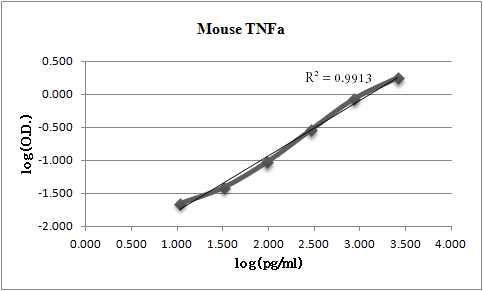 ELISA: Mouse TNF-alpha Biotinylated Antibody [BAF410]. |
追加しました。
Summary
| Application | ELISA |
| Sample Tested | Serum |
| Species | Mouse |
| Other Experimental Details | This antibody was used as the detection antibody in an ELISA. |
追加しました。
Related Product & Information
| Background | TNF-alpha |
|---|---|
| background_content | Background: TNF-alpha Tumor necrosis factor alpha (TNF-alpha, also known as cachectin and TNFSF2), is the prototypic ligand of the TNF superfamily. It is a pleiotropic molecule that plays a central role in inflammation, apoptosis, and immune system development. TNF-alpha is produced by a wide variety of immune and epithelial cell types (1, 2). Mouse TNF-alpha consisits of a 35 amino acid (aa) cytoplasmic domain, a 21 aa transmembrane segment, and a 179 aa extracellular domain (ECD) (3). Within the ECD, mouse TNF-alpha shares 94% aa sequence identity with rat and 70% - 77% with bovine, canine, cotton rat, equine, feline, human, porcine, rat, and rhesus TNF-alpha. The 26 kDa type 2 transmembrane protein is assembled intracellularly to form a noncovalently linked homotrimer (4). Ligation of this complex induces reverse signaling that promotes lymphocyte costimulation but diminishes monocyte responsiveness (5). Cleavage of membrane bound TNF-alpha by TACE/ADAM17 releases a 55 kDa soluble trimeric form of TNF-alpha (6, 7). TNF-alpha trimers bind the ubiquitous TNF RI and the hematopoietic cell-restricted TNF RII, both of which are also expressed as homotrimers (1, 8). TNF-alpha regulates lymphoid tissue development through control of apoptosis (2). It also promotes inflammatory responses by inducing the activation of vascular endothelial cells and macrophages (2). TNF-alpha is a key cytokine in the development of several inflammatory disorders (9). It contributes to the development of type 2 diabetes through its effects on insulin resistance and fatty acid metabolism (10, 11). |
追加しました。
Citations
- Anti-inflammatory Effects of the Natural Compounds Cortex Phellodendri and Humulus japonicus on Pelvic Inflammatory Disease in Mice
Authors: Y Oh, YS Kwon, BD Jung
Int J Med Sci, 2017;14(8):729-734.
Species: Mouse
Sample Type: Tissue Homogenates
Application: ELISA detection - Interferon-gamma regulates inflammatory cell death by targeting necroptosis in experimental autoimmune arthritis
Authors: SH Lee, JY Kwon, SY Kim, K Jung, ML Cho
Sci Rep, 2017;7(1):10133.
Species: Mouse
Sample Type: Cell Culture Supernates
Application: ELISA detection - Oryza sativa (Rice) Hull Extract Inhibits Lipopolysaccharide-Induced Inflammatory Response in RAW264.7 Macrophages by Suppressing Extracellular Signal-regulated Kinase, c-Jun N-terminal Kinase, and Nuclear Factor-?B Activation
Authors: Yoonsook Kim
Pharmacogn Mag, 2016;12(48):295-301.
Species: Mouse
Sample Type: Cell Culture Supernates
Application: ELISA detection - A novel role for protein tyrosine phosphatase 1B as a positive regulator of neuroinflammation
Authors: GJ Song, M Jung, JH Kim, H Park, MH Rahman, S Zhang, ZY Zhang, DH Park, H Kook, IK Lee, K Suk
J Neuroinflammation, 2016;13(1):86.
Species: Mouse
Sample Type: Cell Culture Supernates
Application: ELISA detection - Glimepiride reduces CD14 expression and cytokine secretion from macrophages.
Authors: Ingham V, Williams A, Bate C
J Neuroinflammation, 2014;11(0):115.
Species: Mouse
Sample Type: Cell Culture Supernates
Application: ELISA detection - Regulator of calcineurin 1 suppresses inflammation during respiratory tract infections.
Authors: Junkins R, MacNeil A, Wu Z, McCormick C, Lin T
J Immunol, 2013;190(10):5178-86.
Species: Mouse
Sample Type: BALF
Application: ELISA detection - Rift Valley fever virus infection induces activation of the NLRP3 inflammasome.
Authors: Ermler M, Traylor Z, Patel K, Schattgen S, Vanaja S, Fitzgerald K, Hise A
Virology, 2013;449(0):174-80.
Species: Mouse
Sample Type: Cell Lysates
Application: WB - Response patterns of cytokines/chemokines in two murine strains after irradiation.
Authors: Zhang M, Yin L, Zhang K, Sun W, Yang S, Zhang B, Salzman P, Wang W, Liu C, Vidyasagar S, Zhang L, Ju S, Okunieff P, Zhang L
Cytokine, 2012;58(2):169-77.
Species: Mouse
Sample Type: Plasma
Application: Luminex Assay Development - Increased cytokine production in IL-18 receptor alpha-deficient cells is associated with dysregulation of suppressors of cytokine signaling (SOCS).
Authors: Nold-Petry CA, Nold MF, Nielsen JW, Bustamante A, Zepp JA, Storm KA, Hong JW, Kim SH, Dinarello CA
J. Biol. Chem., 2009;0(0):.
Species: Mouse
Sample Type: Cell Culture Supernates
Application: ELISA Development - ST2 deficient mice display a normal host defense against pulmonary infection with Mycobacterium tuberculosis.
Authors: Wieland CW, van der Windt GJ, Florquin S, McKenzie AN, van der Poll T
Microbes Infect., 2009;11(4):524-30.
Species: Mouse
Sample Type: Cell Culture Supernates
Application: ELISA Development
追加しました。
製品情報は掲載時点のものですが、価格表内の価格については随時最新のものに更新されます。お問い合わせいただくタイミングにより製品情報・価格などは変更されている場合があります。
表示価格に、消費税等は含まれていません。一部価格が予告なく変更される場合がありますので、あらかじめご了承下さい。