HOME> Products> Cell Culture> Imaging dye> PREX710-NHS <Super PhotoStable Dye>

Highly Chemically Stable Light-Resistant Near-Infrared Fluorescent Dye PREX710-NHS <Super PhotoStable Dye>

Date:December 28 2020Web Page No:95010

Funakoshi Co.,Ltd.
Super-Photostable Near Infrared Dye PREX710-NHS

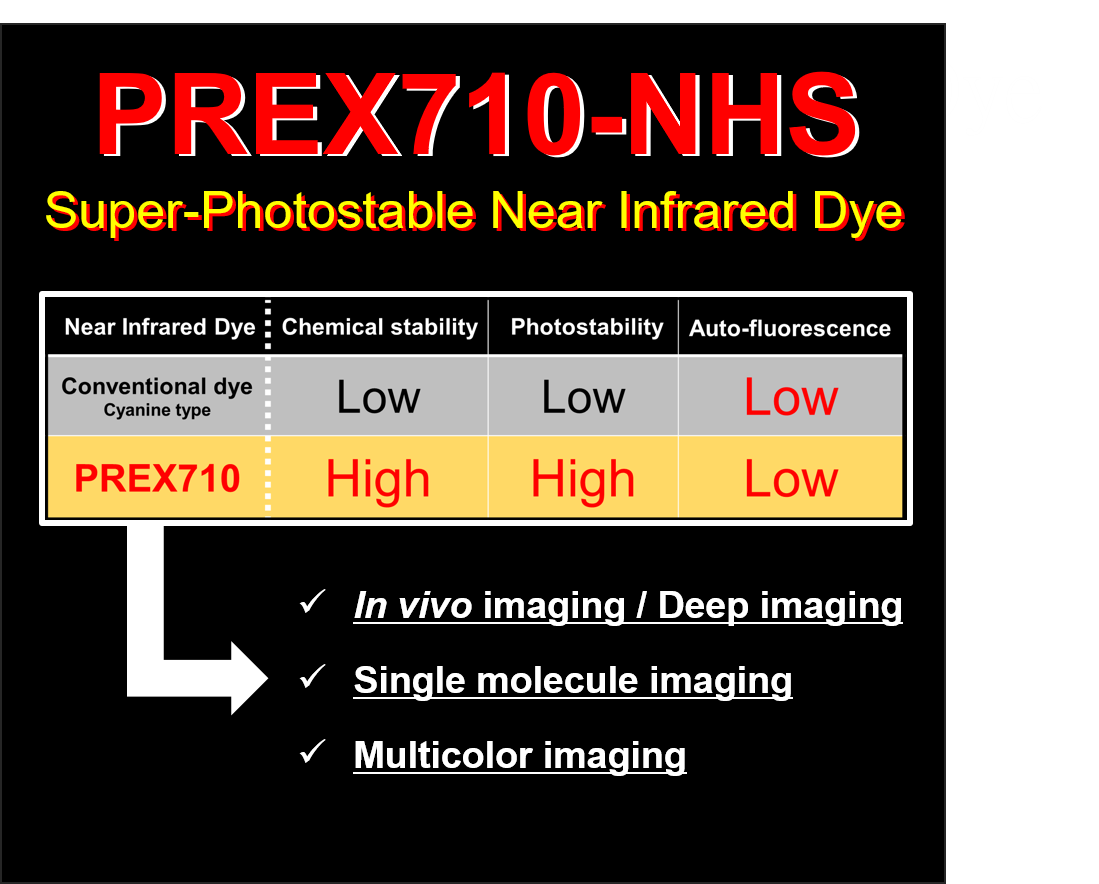
PREX710 is a light-resistant near-infrared dye with high biostability and is useful for in vivo fluorescence imaging, single-molecule imaging, plant imaging with reduced autofluorescence of chloroplasts, and multiple staining. This reagent has an NHS ester and can be labeled specifically with an amino-group.

* This product is not available in US.
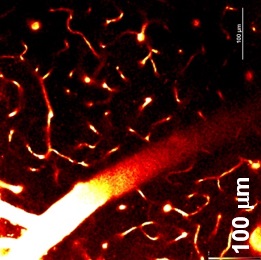
In vivo vascular imaging in mice
100 μm
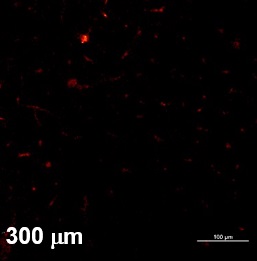
300 μm

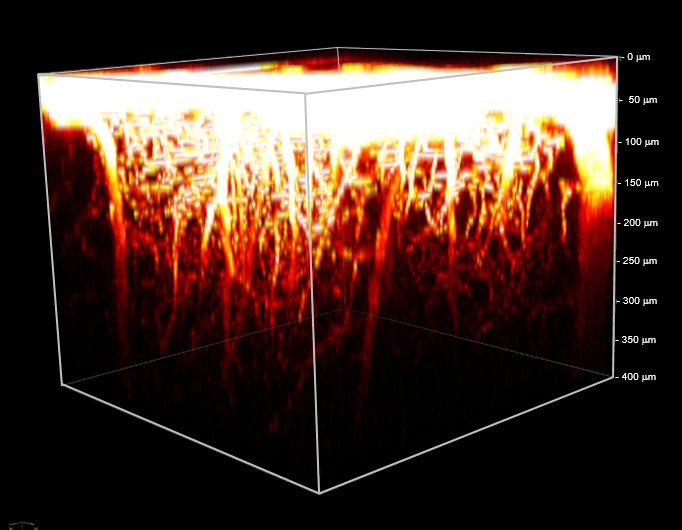
In vivo vascular imaging in mice

PREX710-NHS-labeled aminodextran (average molecular weight, 70,000) was prepared and administered via the tail vein to 4 week-old mice, and deep imaging of cerebral blood vessels was performed by the open skull method using confocal laser microscopy (excitation/fluorescence wavelengths, 638 nm/667-733 nm). PREX710 can be stably maintained in the blood for a long time and can be excited at wavelengths that are not affected by autofluorescence of hemoglobin, which is a problem in blood imaging. Therefore, clear deep imaging of cerebral blood vessels was successfully achieved.
* This data was obtained by Dr. Imamura Lab, Ehime University.

Background

Please click here.

Conventional NIR dyes are not enough for bio-imaging
Near infrared (NIR) dyes absorb and emit light in 700-900 nm, the out of visible light range. As the range of NIR shows low auto-fluorescence from biological samples, NIR dyes are one of the most suitable fluorophore for biological imaging, especially in vivo imaging. A lot of NIR dyes were previously developed and some dyes including indocyanine green (ICG) are commercially available. However almost NIR dyes including indocyanine green (ICG) are based on the cyanine-type dye which contains hydrophobic long polymethine structures and show poor chemical and photostability. Generally, cyanine-type NIR dyes are tend to decompose in the water rapidly and considered as not enough dyes for bio-imaging.

PREX710 enables us to perform long-term bioimaging
A novel NIR dye, PREX710 (Photo Resistant Xanthene Dye 710 nm) is different from conventional cyanine-based NIR dyes because its backbone is a xanthene containing phosphine oxide.

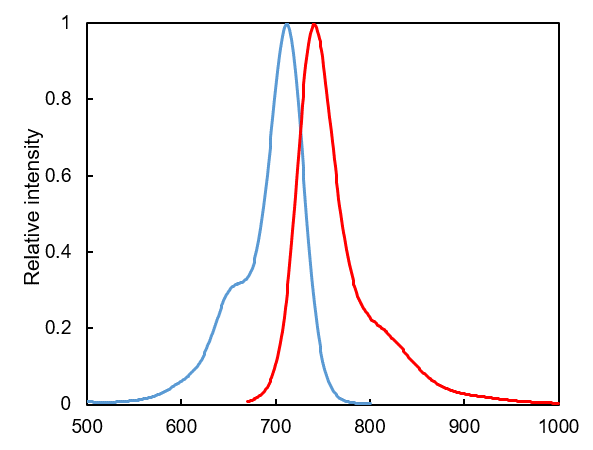
-PREX710 could be excited by around 640-750 nm (max -710 nm) and emit around 700-800 nm (max -760 nm).
-PREX710 shows very highly chemical stability in both water and serum and also exhibits strong photostability.

Combining the above two advantages of PREX710 enables us to monitor in vivo imaging for long term, single molecule imaging, multiplex imaging with visible light fluorophores. PREX710 has been validated in in vivo imaging such as a deep blood vessel imaging in mouse brain, plant imaging omitting auto-fluorescence of chloroplasts, and stable single molecule imaging.

Supplied format: PREX710-NHS
PREX710-NHS (N-hydroxysuccinimide) ester is a reactive form of PREX710 dye suitable for the labeling of amino group-containing molecules such as proteins, antibodies, peptides, amino-nucleotides and any other small compounds. PREX710 conjugates can be applied in various NIR imaging with highly chemical stability and super-photostability.
Go back to index

Features

  • High photostability
  • Stable in water and biological samples
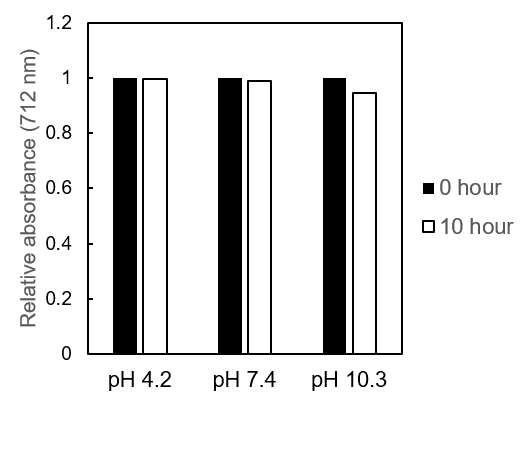
  • Almost unaffected by pH in the pH 4-10
  • Since it is an NHS ester, it can label samples containing amino-groups.
  • Useful for in vivo imaging and single-molecule imaging.
  • When used in plants, it can be observed without being affected by autofluorescence of chloroplasts.
  • Multiple staining is possible by combining with other fluorescent dyes.
  • Ex./Em.: 710 nm/740 nm
  • Quantum yield: 0.12
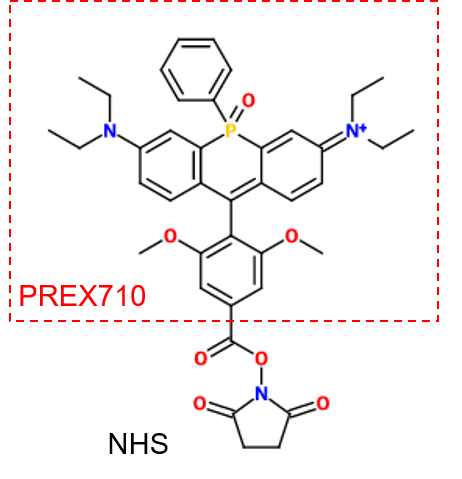
PREX710-NHS Structure

PREX710-NHS Structure

Reference Data

Excitation and Fluorescence Spectra

Excitation and Fluorescence Spectra for PREX710
  • Blue: absorption spectra
  • Red: excitation spectra

pH stability

pH stability for PREX710

To evaluate the pH-dependent stability of PREX710, the time course of absorbance at 712 nm in pH 4.2, 7.4, and 10.3 was measured after 10 hours. Almost no decay of absorbance was observed at any pH, indicating that PREX 4-10 is not affected by pH in the pH range expected in vivo.

Photostability

Photostability for PREX710

To evaluate the photostability of PREX710, PREX710 was dissolved in PBS and irradiated intermittently with a xenon lamp (300 W) to evaluate the decay of absorbance at 712 nm. No change in the absorbance of PREX710 was observed after continuous exposure to a xenon lamp for 2 h.


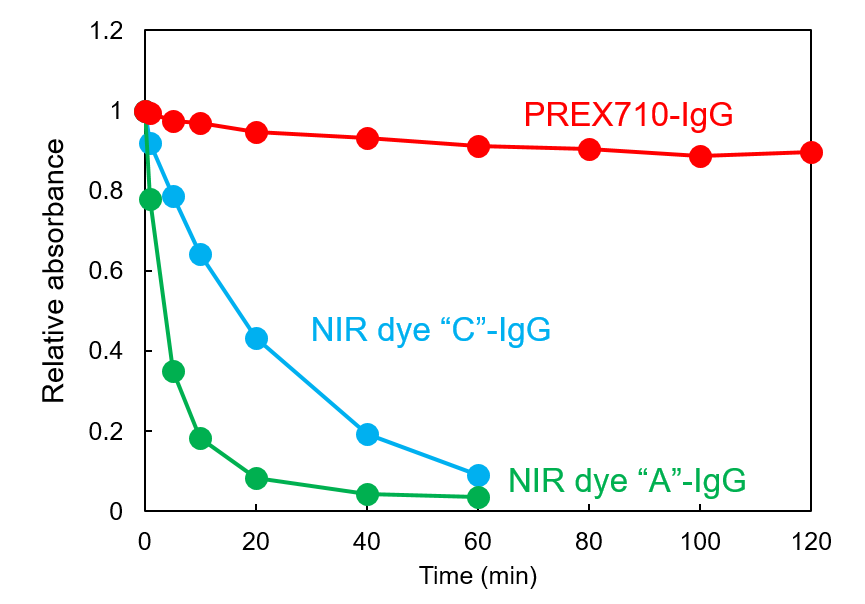
Comparison of Photostability during Protein Labeling

Comparison of Photostability during Protein Labeling

As a labeling model, IgG antibodies were labeled with PREX710-NHS or cyanine competitor dye A-NHS and competitor dye C-NHS ester, respectively, and photostability was evaluated by intermittent irradiation with a xenon lamp (300 W). Rapid absorbance decays were observed for cyanine competitor dye A (NIR dye "A") and cyanine competitor dye C (NIR dye "C"), but little change was observed for PREX710 under prolonged light irradiation even in the IgG antibody-labeled state.


Stability in Blood Serum

PREX710 Stability in Blood Serum

To evaluate the stability of PREX710 in blood, PREX710 was dissolved in FBS (100%) and the change in absorbance at 712 nm was evaluated over 12 hours. PREX710 showed almost no change in absorbance in serum for at least 12 hours, indicating that it is highly stable in serum.


Go back to index

How to Use

This product contains 1 mg of PREX710-NHS (green) in a brown vial, which is filled with argon gas to stabilize the NHS ester. Once opened, the NHS ester may gradually hydrolyze. It is recommended to use this reagent immediately after opening and dissolving.

  1. Just before use, open the vial and immediately dissolve in DMSO or DMF.
    * Note: Dissolution in water is not recommended because hydrolysis reaction proceeds in water. Dehydration grade of DMSO or DMF is recommended. Since NHS ester is unstable in solution, please prepare stock solution immediately before labeling and use immediately. Storage after preparation of stock solution is not recommended because labeling activity may be lost.
  2. Dissolve a sample containing amino-groups to be labeled in 0.1 M carbonate buffer (NaHCO3/Na2CO3, pH 8.3).
    * Note: Phosphate buffer PBS can be substituted. However, buffers containing amino-groups (Tris, glycine, etc.) are not recommended. NHS may react with the buffer and deactivate.
  3. Mix the PREX710-NHS solution and the sample solution and allow to react for at least 1 hour.
    * Note: The amount of dye and sample should be optimized.
  4. Remove unreacted PREX710 dye by gel filtration or ultrafiltration.

Notes on Labeling

The pH during the reaction between NHS ester and amino-groups is very important. Optimal pH is 8.2-8.3. If pH is below 8.0, amino-groups are protonated and the reaction efficiency decreases. On the other hand, if pH is above 8.5, hydrolysis of NHS ester proceeds and the labeling activity is lost.


Go back to index

Application Data

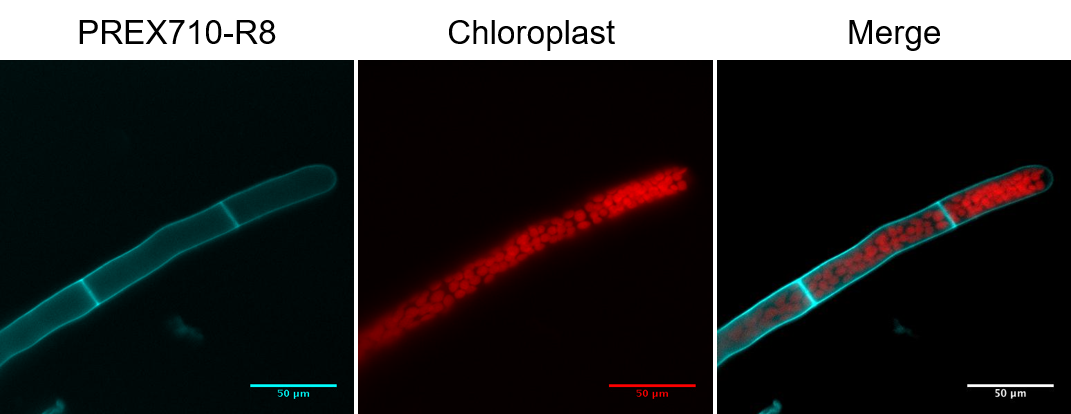
Plant Imaging

PREX710-NHS labeled octaarginine peptide (PREX710-R8) was used to stain the cell wall of Physcomitrella patens and observed by fluorescence microscopy. PREX710-R8 was observed at Ex./Em. = 703-717 nm/754-816 nm, and chloroplasts were detected as autofluorescence at Ex./Em. = 300-400 nm/>420 nm. By using PREX710, clear signals separated from the autofluorescence of chloroplasts could be detected. Since PREX710 is not affected by the autofluorescence of chloroplasts, it is excellent for plant imaging.

Plant imaging with PREX710-R8

Single Molecule Imaging

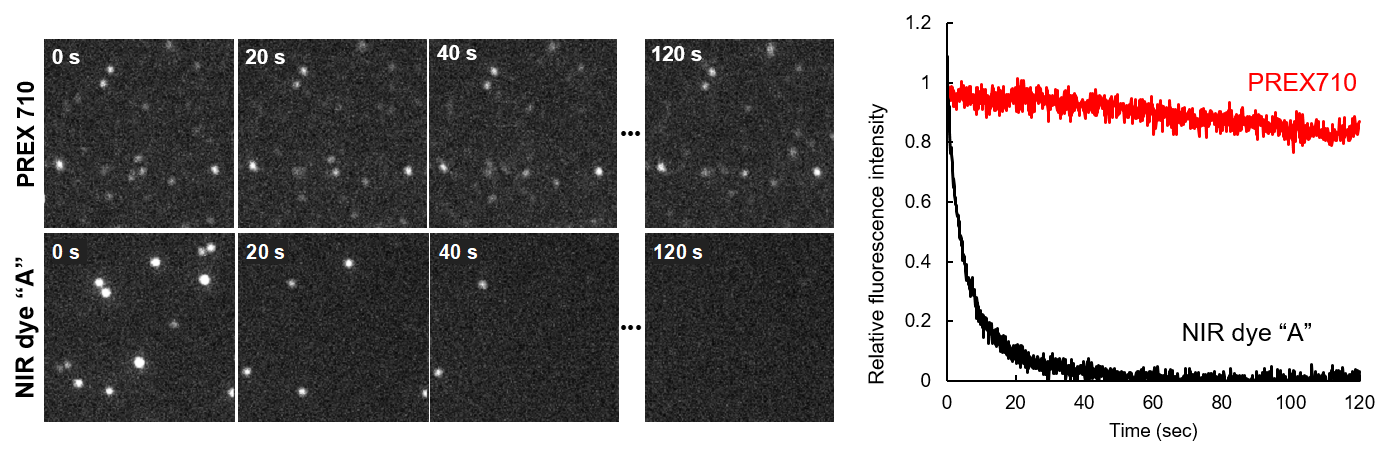
To construct a model for 1 molecule imaging, avidin protein labeled with PREX710-NHS and cyanine competitor A-NHS were prepareded respectively, and bounded them to a biotin solid phase surface. The signal on the dot is the fluorescence signal caused by 1 avidin molecule. The signal of 1 molecule was tracked continuously for 120 s under the acquisition condition of 10 frames/s. In contrast to the cyanine competitor A (NIR dye-"A"), the individual signal gradually decayed and almost completely disappeared after 40 s, the dot signal labeled with PREX710 remained slightly decayed for 120 s even at the 1 molecule level.
* This data was obtained by Dr. Okada Lab, RIKEN.

1 molecule imaging with PREX710

Go back to index

Original Paper

  • Grzybowski, M., et al., Angew. Chem. Int. Ed., 57(32), 10137-10141 (2018). [PMID: 29984448]
    A Highly Photostable Near-Infrared Labeling Agent Based on a Phospha-rhodamine for Long-Term and Deep Imaging

Go back to index

Product Information

[Date : December 08 2025 00:07]

Detail Product Name Product Code Supplier Size Price
PREX710-NHS, Super-Photostable Dye
DatasheetThis may not be the latest data sheet.
FDV-0036 FNAFunakoshi Co.,Ltd. 1 mg $450

Description *This product is not available in US. PREX710 is a super-photostable near infrared (NIR) fluorescent dye with high chemical stability. This is an NHS labeling agent of PREX710, an extremely chemically stable xanthene-type near-infrared fluorescent dye. Modification to any amino group is possible. Compared with existing cyanine dyes, it has a smaller molecular weight and superior chemical stability and light resistance, making it useful for in vivo fluorescence imaging, single-molecule imaging, and multiple staining. (excitation -710 nm/fluorescence -740 nm).
Storage -20°C CAS
Link

[Date : December 08 2025 00:07]

PREX710-NHS, Super-Photostable Dye


  • Product Code: FDV-0036
  • Supplier: FNA
  • Size: 1mg
  • Price: $450

Description *This product is not available in US. PREX710 is a super-photostable near infrared (NIR) fluorescent dye with high chemical stability. This is an NHS labeling agent of PREX710, an extremely chemically stable xanthene-type near-infrared fluorescent dye. Modification to any amino group is possible. Compared with existing cyanine dyes, it has a smaller molecular weight and superior chemical stability and light resistance, making it useful for in vivo fluorescence imaging, single-molecule imaging, and multiple staining. (excitation -710 nm/fluorescence -740 nm).
Storage -20°C CAS
Link

Go back to index

CONTACT

export@funakoshi.co.jp

  • Prices on our website are for your reference only. Please inquire your distributor for your prices.
  • Please note that Product Information or Price may change without notice.