

抗TNF Receptor Ⅰ抗体(Anti-TNF Receptor Ⅰ, Human, Goat-Poly, Biotin antibody)
掲載日情報:2021/01/28 現在Webページ番号:27500

TNF Receptor Ⅰに対する抗体(Anti-TNF Receptor Ⅰ, Human, Goat-Poly, Biotin )です。
※ 本製品は研究用です。研究用以外には使用できません。
追加しました。
- 価格
- Product Details
- Applications and Data
- References
- Related Research Areas
- Summary
- Related Product & Information
- Citations
価格
[在庫・価格 :2026年04月05日 00時00分現在]
| 詳細 | 商品名 |
|
文献数 | ||||||||||||||||||||||||||||||||||||||||||||||||||||||||||||||||||||||||||
|---|---|---|---|---|---|---|---|---|---|---|---|---|---|---|---|---|---|---|---|---|---|---|---|---|---|---|---|---|---|---|---|---|---|---|---|---|---|---|---|---|---|---|---|---|---|---|---|---|---|---|---|---|---|---|---|---|---|---|---|---|---|---|---|---|---|---|---|---|---|---|---|---|---|---|---|---|---|
|
Anti-TNF Receptor I, Human, Goat-Poly, Biotin <Anti-TNFRI> |
|
7 | |||||||||||||||||||||||||||||||||||||||||||||||||||||||||||||||||||||||||||
|
|||||||||||||||||||||||||||||||||||||||||||||||||||||||||||||||||||||||||||||


[在庫・価格 :2026年04月05日 00時00分現在]
Anti-TNF Receptor I, Human, Goat-Poly, Biotin <Anti-TNFRI>
文献数: 7
- 商品コード:BAF225
- メーカー:RSD
- 包装:50μg
- 価格:¥96,000
- 在庫:無(未発注)
- 納期:10日程度 ※※ 表示されている納期は弊社に在庫がなく、取り寄せた場合の目安納期となります。
- 法規制等:
| 説明文 | マッチドペア:Human TNF RI/TNFRSF1A サンドイッチELISAの検出用抗体として利用可能,補足用抗体として#MAB625-500,スタンダードとして#636-R1-025を用いる。 別名:CD120a Genbank No: 7132 |
||
|---|---|---|---|
| 法規制等 | |||
| 保存条件 | -20℃ | 法規備考 | |
| 抗原種 | Human | 免疫動物 | Goat |
| 交差性 | Human | 適用 | ELISA,Western Blot |
| 標識 | Biotin | 性状 | Antigen Affinity Purified |
| 吸収処理 | クラス | IgG | |
| クロナリティ | Polyclonal | フォーマット | |
| 掲載カタログ |
|
||
| 製品記事 | |||
| 関連記事 | R&D Systems(R&Dシステムズ)社 ELISA用ペア抗体を使用したELISA 構築ガイド |
||
追加しました。
Product Details
| Species Reactivity | Human |
|---|---|
| Label | Biotin |
| Immunogen | E. coli-derived recombinant human sTNF RI |
| Source | Polyclonal Goat IgG |
| Purification | Antigen Affinity-purified |
| Specificity | Detects human TNF RI in ELISAs and Western blots. In sandwich immunoassays, less than 0.02% cross-reactivity with recombinant human (rh) TNF‑ alpha, recombinant mouse (rm) TNF‑ alpha, recombinant porcine TNF‑ alpha, recombinant rat TNF‑ alpha, rhTNF‑ beta, rmsTNF RI, rhsTNF RII, and rmsTNF RII is observed. |
追加しました。
Applications and Data
| Recommended Concentration | Sample | |
| Western Blot | 0.1 µg/mL | Recombinant Human TNF RI/TNFRSF1A (Catalog # 636-R1) |
| Human TNF RI/TNFRSF1A Sandwich Immunoassay | Reagent | |
| ELISA Capture (Matched Antibody Pair) | 2-8 µg/mL | Human TNF RI/TNFRSF1A Antibody (Catalog #MAB625 ) |
| ELISA Detection (Matched Antibody Pair) | 0.1-0.4 µg/mL | Human TNF RI/TNFRSF1A Biotinylated Antibody (Catalog #BAF225 ) |
| ELISA Standard | Recombinant Human sTNF RI/TNFRSF1A Protein (Catalog #636-R1 ) | |
| Please Note: Optimal dilutions should be determined by each laboratory for each application.General Protocolsare available in the Technical Information section on our website. | Preparation and Storage | |
| Reconstitution | Reconstitute at 0.2 mg/mL in sterile PBS. | Reconstitution Buffer Available |
| Shipping | The product is shipped at ambient temperature. Upon receipt, store it immediately at the temperature recommended below. | |
| Stability & Storage | Use a manual defrost freezer and avoid repeated freeze-thaw cycles. 12 months from date of receipt, -20 to -70 °C as supplied. | |
| 1 month, 2 to 8 °C under sterile conditions after reconstitution. | ||
| 6 months, -20 to -70 °C under sterile conditions after reconstitution. | ||
| Background: TNF RI/TNFRSF1A | TNF receptor 1 (TNF RI; also called TNF R-p55/p60 and TNFRSF1A) is a type I transmembrane protein member of the TNF receptor superfamily member, designated TNFRSF1A (1, 2). Both TNF RI and TNF RII (TNFRSF1B) are widely expressed and contain four TNF- alpha trimer-binding cysteine-rich domains (CRD) in their extracellular domains (ECD). However, TNF RI is thought to mediate most of the cellular effects of TNF-alpha (3). It is essential for proper development of lymph node germinal centers and Peyer’s patches, and for combating intracellular pathogens such as Listeria (1 - 3). TNF RI is also a receptor for TNF-beta /TNFSF1B (lymphotoxin-alpha ) (4). TNF RI is present on the cell surface as a trimer of 55 kDa subunits (4, 5). TNF-alpha induces sequestering of TNF RI in lipid rafts, where it activates NF kappa B and is cleaved by ADAM-17/TACE (9, 10). Release of the 28 - 34 kDa TNF RI ECD also occurs constitutively and in response to products of pathogens such as LPS, CpG DNA or S. aureus protein A (1, 6 - 8). Full-length TNF RI may also be released in exosome-like vesicles (11). Release helps to resolve inflammatory reactions, since it down-regulates cell surface TNF RI and provides soluble TNF RI to bind TNF-alpha (6, 12, 13). Exclusion from lipid rafts causes endocytosis of TNF RI complexes and induces apoptosis (1). Human TNF RI is a 455 amino acid (aa) protein that contains a 21 aa signal sequence, a 190 aa ECD with a PLAD domain(5) that mediates constitutive trimer formation, followed by the four CRD, a 23 aa transmembrane domain, and a 221 aa cytoplasmic sequence that contains a neutral sphingomyelinase activation domain and a death domain (15). The ECD of human TNF RI shows 80%, 80%, 73%, 69% and 70% aa identity with dog, cat, pig, rat and mouse TNF RI, respectively; it shows 23% aa identity with the ECD of TNF RII. |
|
追加しました。
References
| Pfeffer, K. (2003) Cytokine Growth Factor Rev. 14:185. | |
| Hehlgans, T. and K. Pfeffer (2005) Immunology 115:1. | |
| Peschon, J.J. et al. (1998) J. Immunol. 160:943. | |
| Banner, D.W et al. (1993) Cell 73: 431. | |
| Chan, F.K. et al. (2000) Science 288:2351. | |
| Xanthoulea, S. et al. (2004) J. Exp. Med. 200:367. | |
| Jin, L. et al. (2000) J. Immunol. 165:5153. | |
| Gomez, M.I. et al. (2006) J. Biol. Chem. 281:20190. | |
| Legler, D.F. et al. (2003) Immunity 18:655. | |
| Tellier, E. et al. (2006) Exp. Cell Res. 312:3969. | |
| Islam, A. et al. (2006) J. Biol. Chem. 281:6860. | |
| Garton, K.J. et al. (2006) J. Leukoc. Biol. 79:1105. | |
| McDermott, M.F. et al. (1999) Cell 97:133. | |
| Schneider-Brachert, W. et al. (2004) Immunity 21:415. | |
| Schall, T.J. et al. (1990) Cell 61:361. | |
| Long Name: | Tumor Necrosis Factor Receptor I |
| Entrez Gene IDs: | 7132 (Human); 21937 (Mouse); 25625 (Rat); 102135285 (Cynomolgus Monkey) |
| Alternate Names: | CD120a antigen; CD120a; FPF; p55; p55-R; p60; TNF RI; TNFARMGC19588; TNF-R; TNF-R1; TNFR1TBP1; TNFR55; TNF-R55; TNFR60; TNFRI; TNF-RI; TNF-R-I; TNFR-I; TNFRSF1A; tumor necrosis factor binding protein 1; Tumor necrosis factor receptor 1; tumor necrosis factor receptor 1A isoform beta; tumor necrosis factor receptor superfamily member 1A; tumor necrosis factor receptor superfamily, member 1A; tumor necrosis factor receptor type 1; Tumor necrosis factor receptor type I; tumor necrosis factor-alpha receptor |
追加しました。
Related Research Areas
| Adipocytokines | ||||||||||
| Cell Structure and Signaling Molecules | ||||||||||
| Cytokine and Growth Factor Receptors on VSMC | ||||||||||
| Cytokines and Receptors in Allergy and Asthma | ||||||||||
| Cytokines and Receptors in Angiogenesis | ||||||||||
| Diabetes | ||||||||||
| Diabetic Peripheral Neuropathy | ||||||||||
| EMT Induction | ||||||||||
| Endothelial Cell Markers | ||||||||||
| Neuroinflammation | ||||||||||
| Obesity | ||||||||||
| Platelet Cytokine and Growth Factor Receptors | ||||||||||
| Regulation of Apoptosis by TNF Superfamily Members | ||||||||||
| T Cell Cytokine Signaling | ||||||||||
| TNF Superfamily Receptors | ||||||||||
| ||||||||||
| Images | Ratings | Applications | Species | Reviewed By | Date | Details | ||||
|---|---|---|---|---|---|---|---|---|---|---|
 Enlarge | Excellent | ELISA | Human | Anonymous | 11/22/2017 | Image Details |
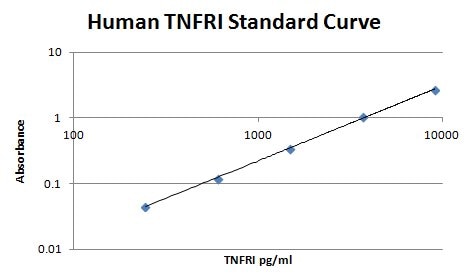 ELISA: Human TNF RI/TNFRSF1A Biotinylated Antibody [BAF225]. | |||
追加しました。
Summary
| Application | ELISA |
| Sample Tested | Serum and Plasma,Cell culture supernatant |
| Species | Human |
| Other Experimental Details | We used MAB625 as the solid phase antibody, 636-R1 as the immunoassay standard and BAF225 as the detection antibody in a sandwich ELISA. Everything worked very well. |
追加しました。
Related Product & Information
| Background | TNF RI/TNFRSF1A |
|---|---|
| background_content | Background: TNF RI/TNFRSF1A TNF receptor 1 (TNF RI; also called TNF R-p55/p60 and TNFRSF1A) is a type I transmembrane protein member of the TNF receptor superfamily member, designated TNFRSF1A (1, 2). Both TNF RI and TNF RII (TNFRSF1B) are widely expressed and contain four TNF- alpha trimer-binding cysteine-rich domains (CRD) in their extracellular domains (ECD). However, TNF RI is thought to mediate most of the cellular effects of TNF-alpha (3). It is essential for proper development of lymph node germinal centers and Peyer’s patches, and for combating intracellular pathogens such as Listeria (1 - 3). TNF RI is also a receptor for TNF-beta /TNFSF1B (lymphotoxin-alpha ) (4). TNF RI is present on the cell surface as a trimer of 55 kDa subunits (4, 5). TNF-alpha induces sequestering of TNF RI in lipid rafts, where it activates NF kappa B and is cleaved by ADAM-17/TACE (9, 10). Release of the 28 - 34 kDa TNF RI ECD also occurs constitutively and in response to products of pathogens such as LPS, CpG DNA or S. aureus protein A (1, 6 - 8). Full-length TNF RI may also be released in exosome-like vesicles (11). Release helps to resolve inflammatory reactions, since it down-regulates cell surface TNF RI and provides soluble TNF RI to bind TNF-alpha (6, 12, 13). Exclusion from lipid rafts causes endocytosis of TNF RI complexes and induces apoptosis (1). Human TNF RI is a 455 amino acid (aa) protein that contains a 21 aa signal sequence, a 190 aa ECD with a PLAD domain(5) that mediates constitutive trimer formation, followed by the four CRD, a 23 aa transmembrane domain, and a 221 aa cytoplasmic sequence that contains a neutral sphingomyelinase activation domain and a death domain (15). The ECD of human TNF RI shows 80%, 80%, 73%, 69% and 70% aa identity with dog, cat, pig, rat and mouse TNF RI, respectively; it shows 23% aa identity with the ECD of TNF RII. |
追加しました。
Citations
- Aminopeptidase P3, a new member of the TNF-TNFR2 signaling complex, induces phosphorylation of JNK1 and JNK2.
Authors: Inoue M, Kamada H, Abe Y, Higashisaka K, Nagano K, Mukai Y, Yoshioka Y, Tsutsumi Y, Tsunoda S
J Cell Sci, 2015;128(4):656-69.
Species: Human
Sample Type: Cell Lysates
Application: WB - Noninvasive detection of acute and chronic injuries in human renal transplant by elevation of multiple cytokines/chemokines in urine.
Authors: Hu H, Kwun J, Aizenstein BD, Knechtle SJ
Transplantation, 2009;87(12):1814-20.
Species: Human
Sample Type: Urine
Application: Antibody Array Development - Clinical outcome following acute ischaemic stroke relates to both activation and autoregulatory inhibition of cytokine production.
Authors: Emsley HC, Smith CJ, Gavin CM
BMC Neurol, 2007;7(0):5.
Species: Human
Sample Type: Plasma
Application: ELISA Development - Direct comparison of traditional ELISAs and membrane protein arrays for detection and quantification of human cytokines.
Authors: Copeland S, Siddiqui J, Remick D
J. Immunol. Methods, 2004;284(1):99-106.
Species: Human
Sample Type: Cell Culture Supernates
Application: Array Development - trans fatty acids and systemic inflammation in heart failure.
Authors: Mozaffarian D, Rimm EB, King IB, Lawler RL, McDonald GB, Levy WC
Am. J. Clin. Nutr., 2004;80(6):1521-5.
Species: Human
Sample Type: Plasma
Application: ELISA Development - A pilot study of pentoxifylline for the treatment of primary sclerosing cholangitis.
Authors: Bharucha AE, Jorgensen R, Lichtman SN, LaRusso NF, Lindor KD
Am. J. Gastroenterol., 2000;95(9):2338-42.
Species: Human
Sample Type: Serum
Application: ELISA Development - Innate immunity associated with inflammatory responses and cytokine production against common dietary proteins in patients with autism spectrum disorder.
Authors: Jyonouchi H, Sun S, Itokazu N
Neuropsychobiology, 0;46(2):76-84.
Species: Human
Sample Type: Cell Culture Supernates
Application: ELISA Development
追加しました。
製品情報は掲載時点のものですが、価格表内の価格については随時最新のものに更新されます。お問い合わせいただくタイミングにより製品情報・価格などは変更されている場合があります。
表示価格に、消費税等は含まれていません。一部価格が予告なく変更される場合がありますので、あらかじめご了承下さい。